Tianjin Botai Heat Exchange Equipment Co.,Ltd

Plate Heat Exchanger Company: Introduction to the Design Advantages of Plate Heat Exchangers
2021-03-23
Plate heat exchanger company: The main parts of the plate heat exchanger are the seals between the plates, the two sealing groove parts, and the inner sides of the end plate and compression plate. The pressure drop is significant: the medium pressure drop at the inlet and outlet exceeds the planned requirements, even many times higher than the planned value, severely affecting the system's flow and temperature requirements.
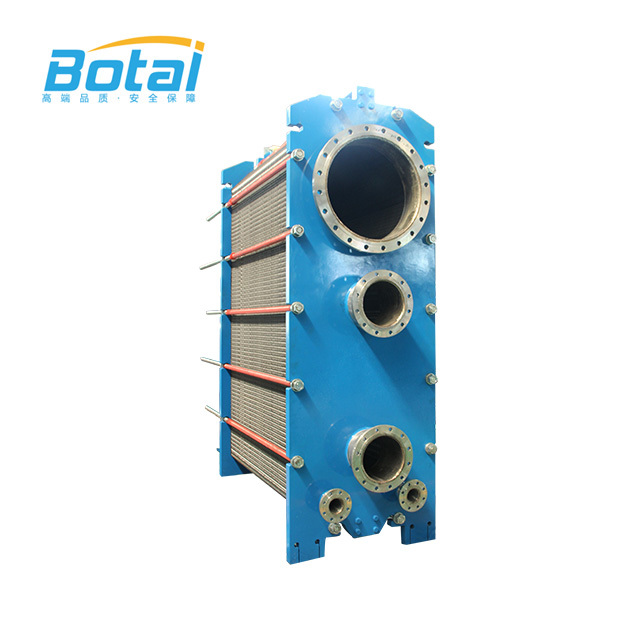
Plate heat exchanger company:Plate heat exchangerThe main part is the seal between the plates, the two sealing groove parts, and the inner sides of the end plates and compression plates. The pressure drop is significant: the medium pressure drop at the inlet and outlet exceeds the planned requirements, even many times higher than the planned value, severely affecting the system's flow and temperature requirements.
Plate heat exchanger company: In heating systems, if the pressure drop on the hot side is too large, the flow on the primary side will be severely insufficient, meaning the heat source will not work, and the outlet temperature on the secondary side will not meet the requirements. Direct liquid: characterized by the connection of the medium on the high-pressure side with the medium on the low-pressure side, resulting in abnormal pressure and temperature in the system. If the medium is corrosive, it may also lead to corrosion of other equipment in the pipeline. Wire drawing fluid usually occurs in the turning area or possibly in the two sealing areas. Heating temperature cannot meet the requirements: characterized by an outlet temperature that is too low to meet the planned requirements.
The plate heat exchanger can change the heat exchange area and process combination according to on-site requirements. Plate heat exchangers are widely used in metallurgy, petroleum, chemical industry, power, chemical fiber, medicine, food, papermaking, and thermal power. They can be used for heating, cooling, evaporation, condensation, and other conditions. It mainly consists of inlet heat-conducting fins, sealing rubber gaskets, clamping bolts, and compression plate structures. It is resistant to various corrosive media.
Plate heat exchanger companyThe plate heat exchanger has high heat transfer efficiency, with hot and cold media passing through adjacent channels for heat exchange. Due to the herringbone corrugation on the plates, the movement of the medium creates turbulence, achieving higher heat exchange efficiency. It is energy-efficient, with a high heat transfer coefficient. The heat transfer coefficient can reach 3000-4500 kcal/m, which is more than three times that of shell-and-tube heat exchangers at the same flow rate.

Address: Baofu No.2, Tianbao Economic Development Zone, Baodi District, Tianjin
Telephone:+86 022-29277918 +86 15510836301
Fax: 022-29277920
E-mail:tjbthrsb88@163.com