Tianjin Botai Heat Exchange Equipment Co.,Ltd

Introduction to the Anti-Corrosion Methods of Welded Plate Heat Exchangers
2021-06-11
Stress corrosion of welded plate heat exchangers is a rupture caused by the combined effects of residual stress in the plates, external forces, and corrosive environments. This rupture occurs rapidly and suddenly with almost no deformation of the plates. Therefore, stress corrosion is one of the most harmful forms of corrosion. Commonly used materials in engineering, such as austenitic stainless steel, copper alloys, titanium alloys, high-strength steel, and high-strength aluminum alloys, are all very sensitive to stress corrosion. These materials can cause stress corrosion even in environments where corrosion is not severe, such as water containing a small amount of Cl-, humid atmospheres, and distilled water.
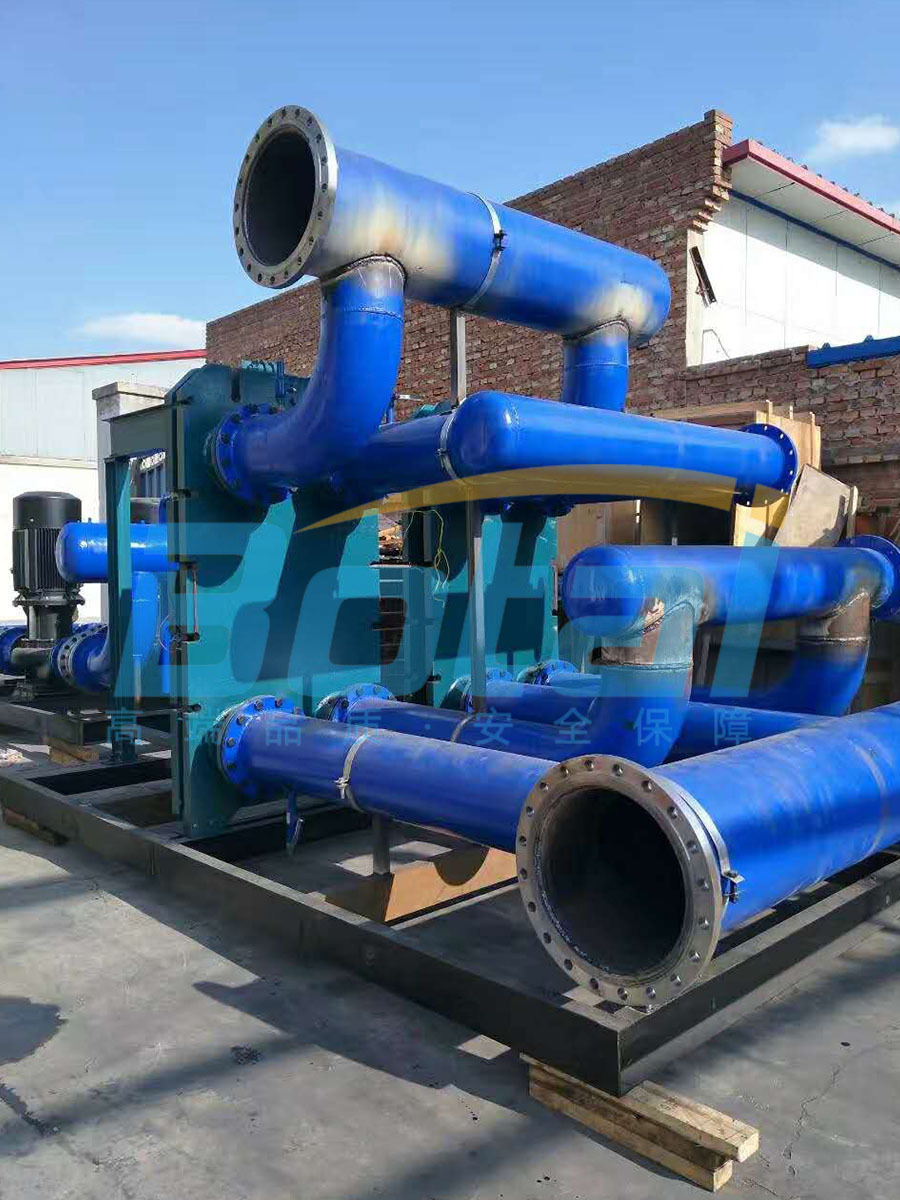
WeldingPlate heat exchangerStress corrosion is the cracking that occurs under the combined effects of residual stress in the plates, external forces, and corrosive environments. This cracking happens rapidly and suddenly with almost no deformation of the plates. Therefore, stress corrosion is one of the most harmful forms of corrosion. Commonly used materials in engineering, such as austenitic stainless steel, copper alloys, titanium alloys, high-strength steel, and high-strength aluminum alloys, are very sensitive to stress corrosion. These materials can cause stress corrosion even in environments that are not very corrosive, such as water containing a small amount of Cl-, humid atmospheres, and distilled water. In welded plate heat exchangers, since welding is required between the plates, between the plate bundles and the connecting plates, between the connecting plates and the tube side end plates, between the end plates and the shell, between the baffle plates and the plate bundles, and between the tube side end plates and the plate side end plates, there will be significant residual stress during the manufacturing process, which provides conditions for the occurrence of stress corrosion.
1. Reasonable process design of plate heat exchangers
To avoid the retention of residual liquid and deposits, double-sided butt welding and continuous welding should be used as much as possible during welding, avoiding lap welding and spot welding. Since the plates are very thin, the addition of filler wire after melting during welding is minimal, which can easily lead to poor weld formation. Therefore, in the welding process, 100% filler wire should be used to ensure good weld formation.
2. Reduce the corrosiveness of the medium
The medium has different effects on different corrosion systems. For example, austenitic stainless steel is prone to stress corrosion in neutral chloride solutions, but as long as the mass concentration of oxygen in the medium is below 1.3 mg/m3, stress corrosion will not occur. Therefore, stress corrosion can be controlled by removing dissolved oxygen and oxidants from the medium. Reducing the mass concentration of Cl- in the medium and strictly controlling the mass concentration of sulfur in the medium are also effective measures to control stress corrosion.
3. Electrochemical protection method for plate heat exchangers
Stress corrosion cracking is an anodic dissolution process under stress. Therefore, electrochemical protection methods can be used for control. The occurrence of stress corrosion cracking in metals or alloys is related to potential, and some systems have a critical rupture potential; exceeding this value will lead to corrosive cracking. More systems have a certain sensitive potential range, which is usually in the passivation activation zone. By using electrochemical polarization methods, the potential of the metal can be moved away from this sensitive potential range. The electrochemical protection method can not only prevent stress corrosion cracking but also, under appropriate protective parameter selection, can stop the expansion of cracks even if they occur. Using sacrificial anode protection or surface spraying of corrosion-resistant metals can sometimes yield good results.
4. Reduce residual stress
Based on practical experience, the stress that causes stress corrosion cracking is mainly residual stress, which is primarily composed of internal stresses caused by cold working and welding. Heat treatment of cold-worked and welded parts helps to eliminate residual stress, thereby also helping to prevent the occurrence of stress corrosion. Therefore, welding operations must strictly adhere to relevant welding procedures. The control of temperature during heat treatment should be appropriate to avoid residual stress caused by heat treatment. However, the method of using heat treatment to eliminate residual stress is not only costly but also has some drawbacks, such as deformation, precipitation of carbides along grain boundaries, formation of oxide scales, and the degree of elimination of internal stress. Therefore, in the manufacturing process of welded plate heat exchangers, it is necessary to comprehensively consider the actual situation to decide whether to adopt stress-relief annealing heat treatment to eliminate residual stress. Other methods to eliminate residual stress, such as hydrostatic testing, vibration aging, shot peening, and hammering, can also be used.
Previous Page:

Address: Baofu No.2, Tianbao Economic Development Zone, Baodi District, Tianjin
Telephone:+86 022-29277918 +86 15510836301
Fax: 022-29277920
E-mail:tjbthrsb88@163.com